
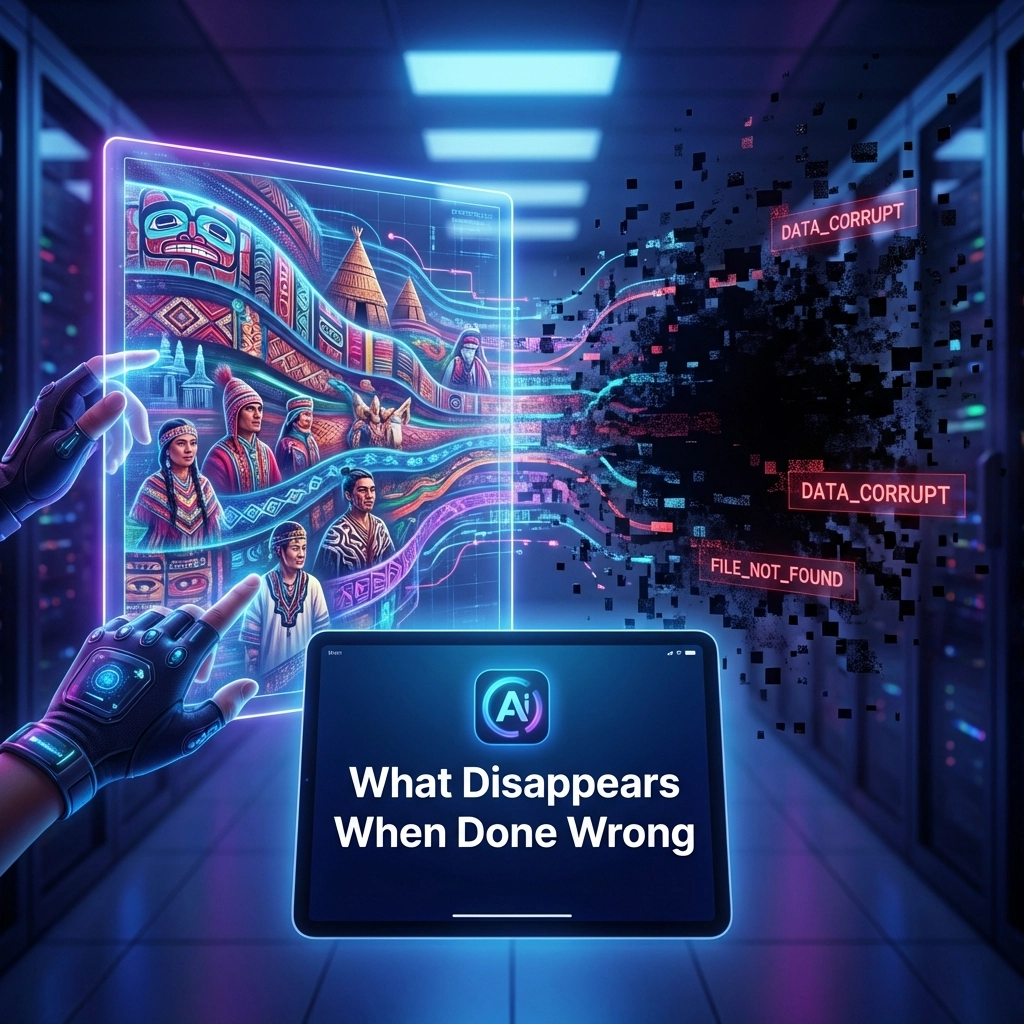
When AI indigenous language preservation efforts are mishandled, the consequences extend far beyond failed technology. What disappears represents generations of trust, cultural wisdom, and the very essence of what makes a language sacred to its speakers. The stakes couldn't be higher: we're not just talking about data loss, but the erosion of cultural identity itself.
Understanding what we risk losing helps us approach indigenous language preservation with the reverence and care these precious linguistic treasures deserve. Every misstep has ripple effects that can last generations, making it crucial to recognize these dangers before they manifest.
Community Trust Vanishes First
The foundation of any successful indigenous language preservation project rests on community trust. When projects are implemented without proper consultation, consent, or ongoing community involvement, this trust disappears rapidly: and once lost, it becomes extraordinarily difficult to rebuild.
Communities that have experienced centuries of exploitation naturally approach new preservation efforts with caution. A single breach of protocol, a mishandled recording, or an unauthorized use of sacred content can shatter relationships that took years to build. The Maori experience with early digital archives offers sobering lessons: when cultural protocols weren't followed, entire communities withdrew from participation, leaving valuable preservation work incomplete.

When trust disappears, communities close their doors. Elders stop sharing. Knowledge keepers retreat. The very people whose participation is essential for authentic preservation become unreachable, creating gaps that no amount of technology can fill.
Cultural Context and Nuance Get Lost
Languages aren't merely collections of words and grammar rules: they're living vessels of cultural understanding. When AI preservation efforts focus solely on linguistic data without cultural context, the soul of the language begins to disappear.
Sacred ceremonies, seasonal greetings, gender-specific speech patterns, and age-appropriate language use represent layers of meaning that generic recording approaches often miss. The Hopi language, for example, contains complex temporal concepts that can't be captured through simple vocabulary lists or basic conversational recordings.
Without proper cultural context, AI systems may inadvertently:
- Mix sacred and everyday language inappropriately
- Lose temporal and ceremonial markers
- Strip away emotional and spiritual dimensions
- Flatten complex social hierarchies embedded in speech patterns
- Miss humor, metaphor, and wordplay that define cultural identity
Sacred Knowledge Becomes Vulnerable
Many indigenous languages contain sacred knowledge that isn't meant for general consumption. When preservation efforts lack proper governance structures, this sacred content can disappear into inappropriate hands or be misused in ways that violate cultural protocols.
Traditional stories may be recorded at wrong seasons, sacred names might be captured in inappropriate contexts, or ceremonial language could be accessed by those not entitled to hear it. The Cherokee Nation faced such challenges when early digitization efforts didn't distinguish between public and sacred content, leading to concerns about spiritual protocols being violated.

When sacred knowledge is mishandled, communities often respond by withdrawing their most precious linguistic elements from preservation efforts entirely. This creates a painful choice between cultural protection and language documentation: a choice that shouldn't have to exist with proper governance in place.
Authentic Pronunciation and Intonation Fade
AI systems trained on poor-quality recordings or insufficient data begin to perpetuate errors that compound over time. When pronunciation models aren't validated by fluent speakers, what disappears is the authentic sound of the language: its natural rhythm, tone, and musicality.
This degradation proves particularly devastating for tonal languages or those with complex phonetic systems. Mandarin Chinese offers a mainstream example: poor AI pronunciation can completely change meaning. For indigenous languages with even more complex sound systems, these errors can render the language unrecognizable to native speakers.
Young learners using corrupted AI models may internalize incorrect pronunciations, creating a generation that speaks a "pseudo-version" of their ancestral language. The real language: the way grandmothers spoke it: disappears behind layers of technological error.
Community Ownership and Control Disappear
When projects are designed and controlled by external organizations, communities lose agency over their own linguistic heritage. This loss of ownership represents more than just control: it's the disappearance of self-determination and cultural sovereignty.
Projects that extract linguistic data without establishing community ownership structures often become digital colonialism. Universities or tech companies may end up holding copyright to indigenous languages, controlling access to cultural content that should belong to the originating communities.
The Inuit experience with early linguistic databases illustrates this danger: when external researchers maintained exclusive control over digitized content, communities found themselves locked out of their own language resources. This kind of dispossession echoes historical patterns of cultural appropriation, making community ownership essential for authentic preservation.
Intergenerational Transmission Breaks Down
One of the most tragic losses occurs when AI preservation efforts inadvertently disrupt natural language transmission between generations. When communities become overly dependent on technological solutions, the organic process of elders teaching youth can begin to disappear.

Some communities report that young people, knowing that AI systems can provide language access, become less motivated to seek out elders for direct instruction. The irreplaceable experience of learning from knowledge keepers: complete with personal stories, cultural corrections, and relational bonding: gets replaced by sterile technological interaction.
When this transmission chain breaks, what disappears isn't just language knowledge but the relationship-building that makes language meaningful. The stories behind words, the family histories embedded in speech patterns, and the emotional connections that make language live all fade away.
Regional Dialects and Variations Get Homogenized
AI systems often struggle with linguistic variation, tending toward standardization that can erase important regional dialects and family-specific speech patterns. When preservation efforts don't account for these variations, entire branches of linguistic diversity disappear.
The Ojibwe language family exemplifies this challenge: with dozens of dialects across different regions, each carrying unique cultural markers and historical significance. AI systems that attempt to create "standard" versions may inadvertently erase the very diversity that makes the language rich and meaningful.
Elders from different regions may find their specific ways of speaking marginalized or "corrected" by AI systems trained primarily on other dialects. This technological pressure toward conformity can accelerate the loss of linguistic diversity that communities are desperately trying to preserve.
Traditional Learning Methods Become Undervalued
When AI preservation projects position technology as the primary solution for language learning, traditional pedagogical methods can begin to seem obsolete. The disappearance of respect for traditional learning approaches represents a fundamental cultural shift that goes far beyond language itself.
Indigenous languages were traditionally learned through ceremony, storytelling, practical activities, and relationship-building. When AI becomes the dominant educational method, these holistic learning approaches may be abandoned, taking with them crucial cultural knowledge that extends beyond mere linguistic competency.

Economic and Social Structures Shift Inappropriately
Poor implementation can disrupt traditional economic and social structures around language use. When external organizations profit from indigenous language data without community benefit, what disappears is the possibility of community-controlled economic development around cultural assets.
Communities may find themselves providing free labor for data collection while private companies monetize their linguistic heritage. This extraction-based model echoes historical exploitation patterns, making community economic participation essential for ethical preservation efforts.
Recovery Becomes Increasingly Difficult
Perhaps most troubling is how quickly recovery becomes impossible once these losses compound. Trust, once broken, may never fully return. Sacred knowledge, once compromised, may be permanently withdrawn from preservation efforts. Young people, once disconnected from traditional learning, may struggle to reconnect with authentic cultural transmission.
The interconnected nature of these losses means that addressing them requires comprehensive, community-centered approaches that prioritize cultural protocols alongside technological capabilities. Prevention becomes infinitely easier than remedy.
Building Safeguards Against Loss
Understanding what disappears when AI indigenous language preservation goes wrong illuminates the path forward. Successful projects must embed cultural protocols, community ownership, and traditional learning methods into their very foundation.
At Ejiogbe Voices, we recognize that technology serves community vision, not the reverse. Our documentation reflects years of learning about these potential losses, incorporating safeguards designed to preserve not just linguistic data but the cultural ecosystems that give language meaning.
The question isn't whether we can use AI for indigenous language preservation: it's whether we can do so with enough wisdom, humility, and community partnership to ensure that what matters most never disappears. The stakes demand nothing less than our most thoughtful, respectful, and culturally grounded approaches to this sacred work.
When done with proper care, indigenous language preservation through AI can strengthen rather than diminish cultural transmission. But the margin for error remains narrow, making community partnership and cultural protocol adherence absolutely essential for success.