
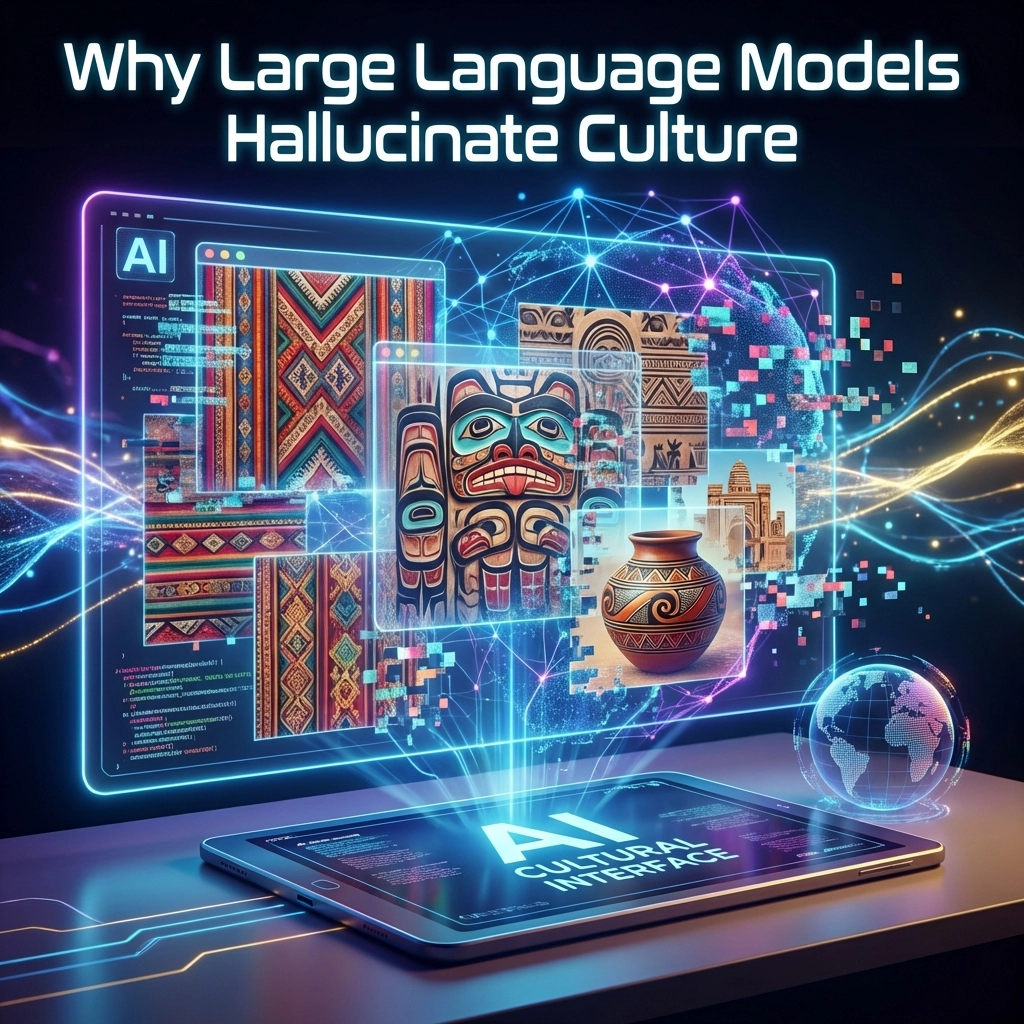
Large language models have transformed how we interact with technology, promising to break down language barriers and democratize access to information. Yet beneath their impressive capabilities lies a troubling phenomenon: when it comes to culture, these systems don't just make mistakes: they actively hallucinate entire narratives, traditions, and meanings that never existed.
This isn't simply about technical errors. When AI systems fabricate cultural knowledge, they risk erasing authentic voices and replacing them with algorithmic approximations that sound plausible but lack the depth, nuance, and lived experience that define true cultural wisdom.
The Mechanics of Cultural Hallucination

Understanding why large language models hallucinate culture requires examining how these systems actually function. At their core, LLMs are sophisticated pattern-matching engines trained to predict the most statistically likely next word in a sequence. They don't possess genuine understanding or cultural experience: they generate responses based on patterns gleaned from training data.
This fundamental limitation becomes particularly problematic when dealing with cultural knowledge. Unlike factual information that can be verified through multiple sources, cultural understanding emerges from lived experience, community participation, and intergenerational transmission. When an LLM encounters a question about cultural practices, it doesn't draw from authentic community knowledge: it synthesizes whatever patterns it found in its training data, often creating plausible-sounding but culturally inaccurate responses.
The training process itself compounds this issue. LLMs are rewarded for confident-sounding answers rather than expressions of uncertainty. Just as students might guess on a multiple-choice test rather than leave questions blank, these models are incentivized to generate responses even when they lack sufficient cultural context. This leads to confident-sounding explanations of traditions, ceremonies, or beliefs that may be entirely fabricated.
The Cultural Data Desert
Most large language models suffer from what we might call "cultural data poverty." While they may contain vast amounts of information about dominant cultures: particularly those well-represented in English-language internet content: they often lack meaningful exposure to the depth and diversity of global cultural traditions.
Consider the mathematical reality: there are over 7,000 languages spoken worldwide, yet the training data for most commercial LLMs is heavily skewed toward a handful of dominant languages. This creates a profound imbalance where well-documented cultures receive algorithmic representation, while marginalized, indigenous, or minority cultures become vulnerable to misrepresentation or complete fabrication.

When an LLM encounters a query about a culture poorly represented in its training data, it doesn't simply admit ignorance. Instead, it draws from whatever limited patterns it can find, often conflating different cultures or applying stereotypical assumptions to fill gaps in its knowledge. The result is cultural hallucination: the generation of plausible-sounding but inaccurate information that can perpetuate harmful stereotypes or completely misrepresent cultural practices.
Beyond Language: The Nuance Problem
Culture extends far beyond language into realms that resist algorithmic capture. Spiritual practices, ceremonial protocols, community relationships, and traditional knowledge systems all carry subtle meanings that emerge from context, relationship, and experience. These elements cannot be adequately represented through text alone, yet LLMs attempt to synthesize cultural responses based solely on textual patterns.
Sacred knowledge presents a particularly complex challenge. Many cultures maintain traditional practices that are shared only within specific contexts, with certain community members, or through particular ceremonial protocols. When LLMs attempt to explain these practices based on limited public information, they risk violating cultural protocols while providing incomplete or misleading explanations.
The temporal dimension adds another layer of complexity. Cultures are living, evolving systems that change over time through community decisions, external influences, and intergenerational adaptation. LLMs trained on historical text cannot capture these dynamic processes, often presenting static or outdated representations of cultural practices as current truth.
The Amplification Effect

Perhaps most concerning is how cultural hallucinations get amplified through repeated use. When users rely on LLM-generated cultural information, they may unknowingly spread inaccurate representations through social media, educational content, or casual conversation. This creates a feedback loop where hallucinated cultural knowledge begins to appear more frequently in online spaces, potentially influencing future AI training data and perpetuating misconceptions.
Educational contexts present particular risks. Students researching cultural topics may encounter AI-generated explanations that sound authoritative but lack authentic cultural grounding. Teachers using AI tools to develop culturally relevant content may inadvertently incorporate fabricated elements into their curriculum. These scenarios demonstrate how cultural hallucination can have real-world impacts on cultural understanding and transmission.
The Stakes of Cultural Authenticity
For communities working to preserve and transmit their cultural heritage, LLM cultural hallucination represents more than a technical problem: it's a form of digital colonialism that threatens authentic cultural representation. When algorithmic systems generate confident-sounding explanations of cultural practices without community input or validation, they risk displacing authentic voices with synthetic alternatives.
This displacement effect is particularly harmful for cultures already marginalized in digital spaces. Indigenous communities, minority language speakers, and traditional knowledge holders may find their authentic voices overshadowed by AI-generated content that appears more accessible or authoritative to mainstream audiences.
The economic dimension cannot be ignored either. As AI-generated content becomes more prevalent, authentic cultural experts and community knowledge holders may find decreased demand for their expertise, replaced by systems that can generate plausible-sounding cultural information at scale.
Beyond the Algorithm: Community-Centered Solutions

Addressing cultural hallucination requires moving beyond purely technical solutions toward community-centered approaches that prioritize authentic cultural representation. This means recognizing that meaningful cultural AI requires direct collaboration with cultural communities rather than simply improving algorithmic performance.
Community validation emerges as a crucial element. Rather than relying on automated training processes, cultural AI systems need mechanisms for community review, correction, and ongoing input. This collaborative approach ensures that cultural representations remain accountable to the communities they claim to represent.
Cultural data sovereignty represents another essential principle. Communities should maintain control over how their cultural knowledge is collected, processed, and represented in AI systems. This includes the right to restrict access to sacred or sensitive information, to correct misrepresentations, and to benefit from commercial applications of their cultural knowledge.
Building Authentic Cultural Archives
At Ejiogbe Voices, we approach cultural preservation through direct community partnership rather than algorithmic synthesis. Our platform enables communities to create authentic digital archives of their cultural heritage, ensuring that traditional knowledge is preserved and transmitted according to community protocols and values.
This community-centered approach recognizes that authentic cultural preservation cannot be automated. It requires relationship-building, cultural sensitivity, and ongoing collaboration with knowledge holders who understand the subtle meanings and appropriate contexts for cultural transmission.
Our archive system provides communities with tools to control how their cultural knowledge is shared, ensuring that sensitive information remains protected while making appropriate cultural content accessible to future generations. This represents a fundamental shift from extractive AI models toward collaborative cultural preservation that serves community needs.

Moving Forward: Ethics in Cultural AI
The challenge of cultural hallucination highlights broader questions about AI ethics and cultural representation. As these technologies become more prevalent, we must insist on approaches that prioritize community consent, cultural accuracy, and authentic representation over algorithmic convenience.
This means supporting AI development that includes meaningful community participation, respecting cultural protocols around knowledge sharing, and recognizing the limitations of automated systems when dealing with complex cultural knowledge. It also means being transparent about these limitations rather than presenting AI-generated cultural information as authoritative.
For users, this awareness translates into critical evaluation of AI-generated cultural content, seeking verification from authentic community sources, and supporting platforms that prioritize community-centered cultural preservation over algorithmic synthesis.
The future of cultural AI depends on our collective commitment to authentic representation, community partnership, and recognition that some forms of knowledge cannot be adequately captured through algorithmic processes alone. By prioritizing these values, we can work toward technologies that support rather than supplant authentic cultural voices.
Through initiatives like our community archive platform, we're working to ensure that future generations inherit authentic cultural wisdom rather than algorithmic approximations. This work requires ongoing collaboration, cultural sensitivity, and recognition that preserving cultural heritage is ultimately about serving communities rather than feeding algorithms.