
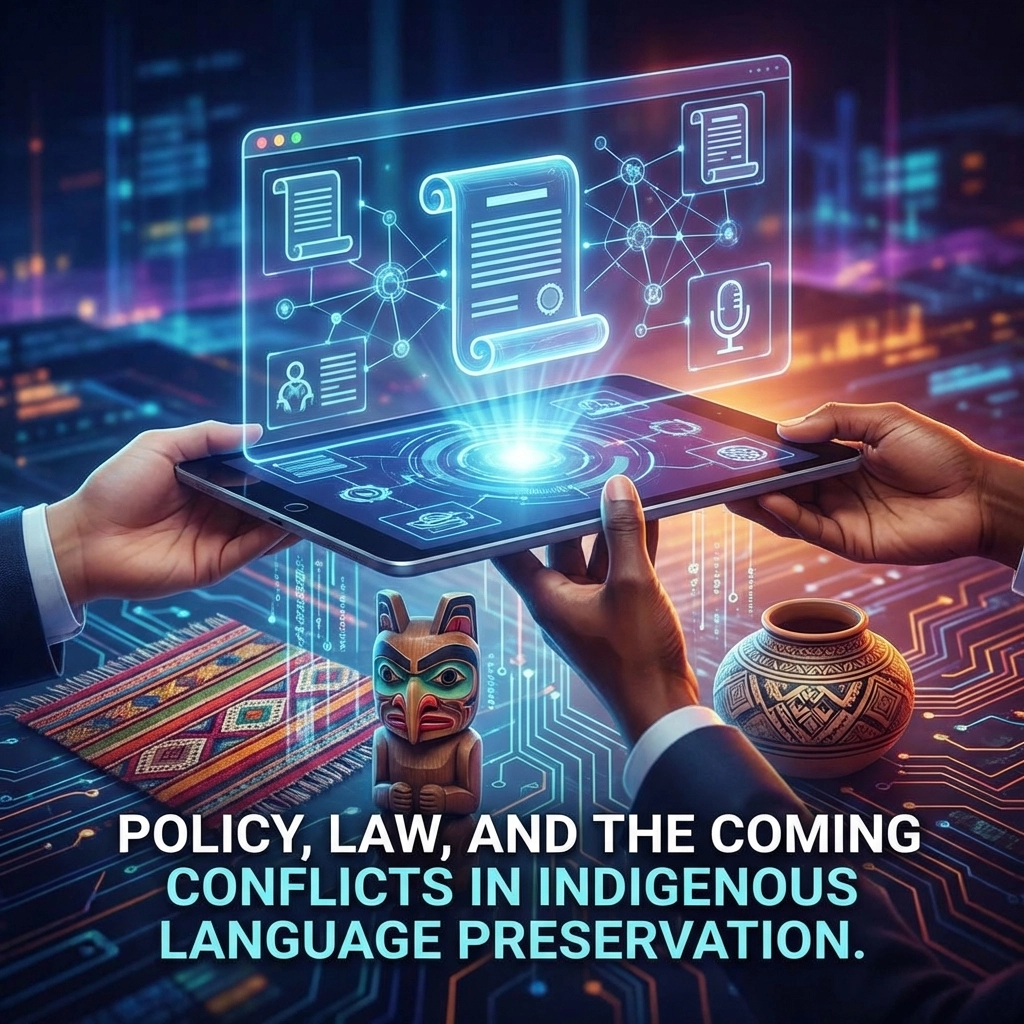
The landscape of indigenous language preservation stands at a critical crossroads. While federal initiatives like the 10-Year National Plan on Native Language Revitalization promise unprecedented investment: $624 million annually to increase proficient Native language speakers by 25% before 2036: the legal and policy frameworks governing this sacred work remain fragmented and inadequate. As communities rush to digitize ancestral voices and AI technologies accelerate the pace of language documentation, we face an emerging crisis that threatens the very sovereignty these efforts seek to protect.
The Collision Course: Technology Meets Tradition
The urgency driving indigenous language preservation has created an unprecedented convergence of technology, policy, and cultural sovereignty. Communities are uploading precious recordings to digital platforms, training AI systems on sacred speech patterns, and creating databases of ancestral knowledge: all while operating within legal structures that were never designed to protect oral traditions.

This technological revolution carries profound promise. The federal plan envisions 100 new K-12 Native language immersion schools, 37 preservation centers at tribal colleges, and training for 10,000 Native language teachers. A $100 million innovation fund specifically targets curriculum and technology development. Yet beneath these ambitious goals lies a troubling reality: our legal system fundamentally misunderstands the nature of indigenous intellectual property.
Copyright Law's Fundamental Failure
Traditional copyright law operates on principles of individual ownership, fixed expression, and limited duration: concepts that are antithetical to how indigenous communities understand their linguistic heritage. When an elder shares a traditional story, they are not creating "original work" subject to individual ownership. They are transmitting collective wisdom that belongs to the community across generations.
The Esther Martinez Native American Languages Preservation Act, reauthorized through 2024, provides community-based grants but offers no protection for the intellectual property created through these federally funded efforts. A traditional song recorded under this act exists in a legal void: neither protected by copyright's individual ownership model nor safeguarded by any framework that recognizes communal cultural property.
This creates immediate vulnerabilities. When communities upload language materials to digital platforms, they often unknowingly surrender control through terms of service agreements designed for individual content creators. The sacred becomes subjected to corporate data policies written in Silicon Valley boardrooms.
AI Training and the Indigenous Exposure Crisis
The explosion of AI language models presents the most immediate threat to indigenous linguistic sovereignty. Major tech companies are scraping vast amounts of digital content to train their systems, and indigenous language materials uploaded to academic repositories, cultural institutions, and even tribal websites are increasingly at risk of unauthorized extraction.

Unlike other forms of cultural appropriation, AI training creates permanent, scalable copies of linguistic patterns that can be reproduced infinitely without community consent or compensation. When a language model learns to generate text in Navajo, Cherokee, or Ojibwe, it has essentially colonized those linguistic structures for commercial purposes.
The recent wave of AI training lawsuits: including cases against OpenAI, Meta, and other major players: focuses primarily on copyrighted text and code. Indigenous communities lack the legal standing and resources to pursue similar claims, creating a two-tiered system where some intellectual property receives aggressive legal protection while indigenous linguistic heritage remains vulnerable to extraction.
Governmental Unpreparedness at Every Level
Federal agencies championing indigenous language revitalization demonstrate a troubling disconnect between their preservation goals and their understanding of the legal complexities involved. The 10-Year National Plan allocates substantial funding for digitization and technology development while remaining silent on intellectual property protection, data sovereignty, and community consent protocols.
State governments prove even less prepared. Most lack specific legislation addressing indigenous cultural intellectual property, leaving communities to navigate a patchwork of inadequate federal laws and irrelevant state statutes. When conflicts arise: and they will: indigenous communities will find themselves defending their linguistic sovereignty in courts that fundamentally misunderstand the communal nature of their cultural property.
Academic institutions, despite their role as trusted repositories for indigenous materials, operate under institutional review board protocols designed for individual research subjects, not collective cultural property. Universities hosting indigenous language archives often lack clear policies governing AI training access, commercial licensing, or community withdrawal of consent.

The Coming Legal Battlegrounds
Several specific conflicts are already emerging and will likely intensify in the coming years:
Data Sovereignty vs. Open Access: Academic and cultural institutions increasingly promote open access to indigenous materials to support revitalization efforts. Yet unrestricted digital access facilitates unauthorized AI training and commercial exploitation. Communities must choose between broader access for educational purposes and protecting their linguistic sovereignty.
Federal Funding Conditions: As federal investment in indigenous language preservation grows, so do compliance requirements that may conflict with traditional governance structures. The shift from competitive grants to direct tribal funding through mechanisms like Public Law 638 contracts may seem empowering but could create new forms of federal oversight over cultural practices.
Cross-Border Language Communities: Many indigenous languages span national boundaries. Canadian and Mexican policies differ significantly from U.S. approaches, creating jurisdictional gaps that leave cross-border linguistic communities vulnerable to inconsistent protection.
Commercial AI Integration: Major technology companies are beginning to specifically target indigenous languages for AI development, often framing this as "preservation" or "accessibility" work. Without clear legal frameworks, communities lack leverage to negotiate fair terms or maintain control over how their languages are implemented in commercial products.
What Communities Must Demand Now
The window for establishing protective legal frameworks is rapidly closing. Indigenous communities cannot wait for governments to develop appropriate policies: they must demand specific protections immediately:
Tribal Data Sovereignty Legislation: Every state with significant indigenous populations needs comprehensive tribal data sovereignty laws that recognize communal intellectual property rights and establish clear protocols for digital consent, withdrawal, and compensation.
Federal AI Training Transparency: Indigenous communities should demand that any AI company training models on indigenous language data publicly disclose those sources, obtain explicit community consent, and provide ongoing compensation and control mechanisms.
Institutional Policy Reform: Academic institutions hosting indigenous language materials must implement community-controlled access policies that prevent unauthorized AI training while supporting legitimate preservation and education efforts.

Cultural IP Legal Standing: Indigenous communities need explicit legal standing to pursue intellectual property claims as collective entities, not just as individuals. This requires federal legislation recognizing communal cultural property as a distinct legal category.
The Path Forward: Sovereignty Through Preparation
The conflicts ahead are not inevitable catastrophes but predictable challenges that communities can prepare for now. The Ejiogbe Voices platform represents one approach: providing technical infrastructure designed with indigenous sovereignty principles from the ground up, including community-controlled access layers and explicit AI training restrictions.
However, technology alone cannot solve legal and policy problems. Communities must engage proactively with lawmakers, academic institutions, and tech companies before conflicts escalate into expensive legal battles. The 10-Year National Plan's substantial investment creates leverage that communities should use to demand comprehensive legal protections as a condition of participation.
Building Protective Infrastructure
The most successful indigenous language preservation efforts will be those that build legal and technical infrastructure simultaneously. This means developing community policies governing digital consent, creating technical platforms with community-controlled access layers, and establishing legal partnerships that can respond quickly to emerging threats.
Every recording uploaded, every database created, and every AI system trained represents either a step toward indigenous linguistic sovereignty or a movement toward digital colonization. The legal and policy frameworks governing these choices will determine whether the massive investment in indigenous language revitalization empowers communities or simply creates more sophisticated forms of cultural extraction.
The conflicts ahead are real, urgent, and largely preventable: but only if communities act now to establish the legal and policy protections their linguistic sovereignty requires. The ancestors' voices deserve nothing less than the full protection of law, and the coming generations depend on the decisions communities make today.