
In the sacred work of preserving indigenous languages, we stand at a crossroads where ancient wisdom meets modern innovation. The question before us is not whether artificial intelligence will impact cultural preservation: it already has. The crucial question is how we shape that impact to honor, protect, and amplify our ancestral voices rather than silence them.
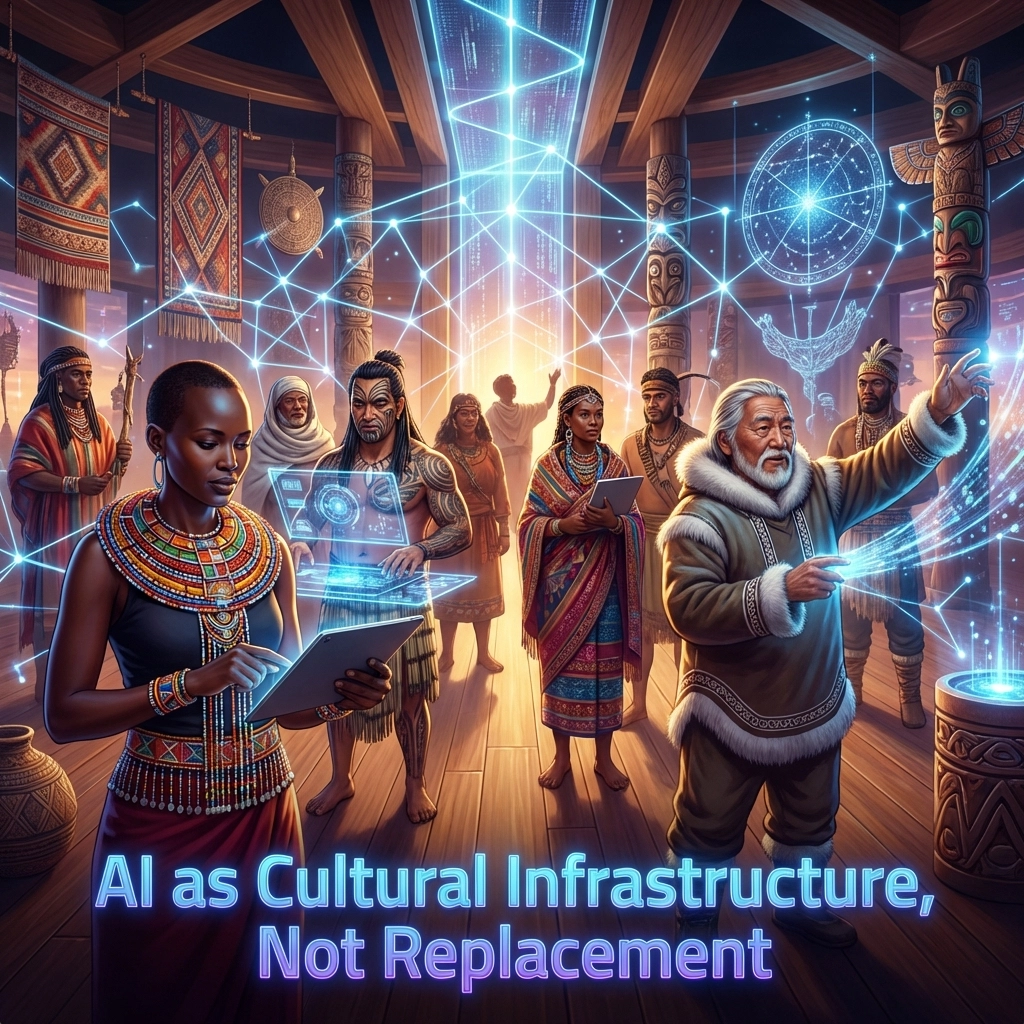
AI represents neither salvation nor threat in isolation. Instead, it offers something more nuanced and powerful: the opportunity to build cultural infrastructure that strengthens existing communities, traditions, and knowledge systems. When we approach AI as infrastructure rather than replacement, we create pathways for our languages to flourish in digital spaces while maintaining their sacred connection to community, ceremony, and lived experience.
Understanding Cultural Infrastructure
Cultural infrastructure encompasses the invisible networks that sustain community life: the gatherings where elders share stories, the ceremonies where prayers are spoken in ancestral tongues, the quiet moments when grandmothers teach grandchildren the words that carry generations of wisdom. This infrastructure includes physical spaces like community centers and cultural museums, but extends far beyond buildings to encompass the relationships, practices, and systems of knowledge transmission that keep cultures alive.

Indigenous language preservation has always relied on robust cultural infrastructure. The most successful revitalization efforts happen when communities have strong networks of speakers, regular opportunities for practice, educational resources, and intergenerational connections. AI doesn't replace any of these elements: instead, it can strengthen the foundations that make them possible.
When we build AI tools for language preservation, we're not creating substitutes for human connection. We're creating bridges that span distance, time, and circumstance to help our people access their heritage more easily. A well-designed AI system becomes part of the infrastructure that supports language learning, just as a community center becomes part of the infrastructure that supports cultural gatherings.
AI as Enhancement, Not Replacement
The most profound insight in indigenous language preservation is that AI succeeds when it amplifies human voices rather than generating artificial ones. Our languages carry more than vocabulary and grammar: they carry worldviews, spiritual concepts, and ways of understanding relationships that cannot be replicated by algorithms alone.
AI excels at tasks that support human connection: digitizing audio recordings to make them searchable and accessible, creating pronunciation guides that help learners practice, organizing vast archives of cultural materials so families can find recordings of their ancestors. These technological capabilities enhance the work that communities are already doing rather than replacing the irreplaceable bonds between speaker and learner.

Consider how AI-powered transcription can transform a collection of elder recordings into searchable resources for language learners. The AI doesn't replace the elder's voice: it makes that voice more accessible to future generations who might otherwise never hear it. The technology serves as infrastructure, creating pathways for knowledge to flow from one generation to the next.
Similarly, AI can identify patterns in language usage that help communities understand how their languages are evolving and adapting. This analysis doesn't replace human linguistic knowledge: it provides data that supports community decisions about language planning and educational priorities.
The Sacred Balance: Technology Serving Culture
Indigenous communities have always been innovators, adapting new tools and technologies to serve cultural needs while maintaining core values and practices. The integration of AI into language preservation continues this tradition of thoughtful innovation guided by community wisdom.
The sacred balance requires that technology serves culture, not the reverse. When AI systems are designed with community input and governance, they become tools that extend traditional knowledge systems into digital spaces. When they're designed without community involvement, they risk extracting cultural knowledge without giving back to the communities that created it.
Effective AI infrastructure for language preservation includes robust consent mechanisms, community ownership of data, and decision-making processes that keep cultural authorities in control of how their languages are represented and used. The technology adapts to cultural protocols rather than forcing cultures to adapt to technological limitations.

This balance manifests in practical design decisions: ensuring that AI systems can handle the tonal complexities of indigenous languages, incorporating traditional teaching methods into digital learning interfaces, and building platforms that encourage community interaction rather than isolated study.
Building Bridges, Not Barriers
AI infrastructure succeeds when it connects rather than isolates. The most powerful applications create bridges between generations, linking elders who carry traditional knowledge with young people who will carry it forward. They connect diaspora communities with ancestral homelands, urban indigenous youth with traditional speakers, and contemporary language learners with historical recordings.
These bridges take many forms. Voice recognition systems can help learners practice pronunciation by comparing their speech with elder recordings. Digital archives can connect families with recordings of ancestors they never had the chance to meet. Translation tools can help bilingual speakers navigate between their indigenous language and dominant languages in educational and professional settings.
The key insight is that these technological bridges strengthen existing relationships rather than replacing them. A young person using an AI pronunciation guide isn't replacing traditional mentorship: they're preparing themselves to engage more effectively with elders and traditional speakers in their community.
Governance for Cultural Preservation
Building AI as cultural infrastructure requires governance frameworks that prioritize community needs over technological capabilities. Indigenous communities must retain sovereignty over their linguistic and cultural data, making decisions about how AI systems access, analyze, and represent their languages.
Effective governance includes transparent partnerships between communities and technology developers, clear protocols for data ownership and usage, and mechanisms for communities to modify or discontinue AI systems that don't serve their needs. This governance extends beyond legal frameworks to include cultural protocols that ensure AI development respects traditional knowledge systems.

The most successful AI preservation projects involve communities as partners in design and development rather than merely as data sources. Communities define success metrics that go beyond technological functionality to include cultural appropriateness, educational effectiveness, and community acceptance.
This collaborative approach ensures that AI systems evolve with community needs and priorities. As language revitalization efforts mature and change, the supporting technology can adapt rather than becoming obsolete or counterproductive.
The Path Forward
Building AI as cultural infrastructure requires long-term commitment to community partnership, ongoing investment in culturally appropriate technology development, and recognition that the most important outcomes cannot be measured in lines of code or dataset sizes. Success is measured in the voices of children speaking their ancestral languages, the confidence of learners engaging with their heritage, and the strength of communities maintaining their linguistic traditions.
The future of AI in indigenous language preservation lies not in replacing human connections but in creating technological infrastructure that makes those connections stronger, more frequent, and more accessible across time and space. When we build AI as infrastructure rather than replacement, we create pathways for our languages to thrive in digital spaces while maintaining their deep roots in community, ceremony, and lived experience.

Our mission at Ejiogbe Voices centers on building this kind of respectful, community-centered infrastructure. We understand that preserving indigenous languages means more than preserving words: it means preserving the cultural contexts that give those words meaning and power.
As we move forward, the challenge is not to build perfect AI systems, but to build systems that serve community needs while respecting community sovereignty. This requires ongoing dialogue, adaptive technology design, and unwavering commitment to ensuring that AI enhances rather than threatens the cultural infrastructure that keeps our languages alive.
The path forward is clear: AI as infrastructure, not replacement. Technology in service of culture, not culture in service of technology. Innovation guided by wisdom, community sovereignty preserved through thoughtful partnership, and digital tools that strengthen rather than weaken the bonds between generations.
In this work, we don't just preserve languages: we preserve the relationships, knowledge systems, and cultural practices that give those languages life and meaning. AI becomes part of our cultural infrastructure, supporting the sacred work of ensuring that ancestral voices continue to guide future generations.