
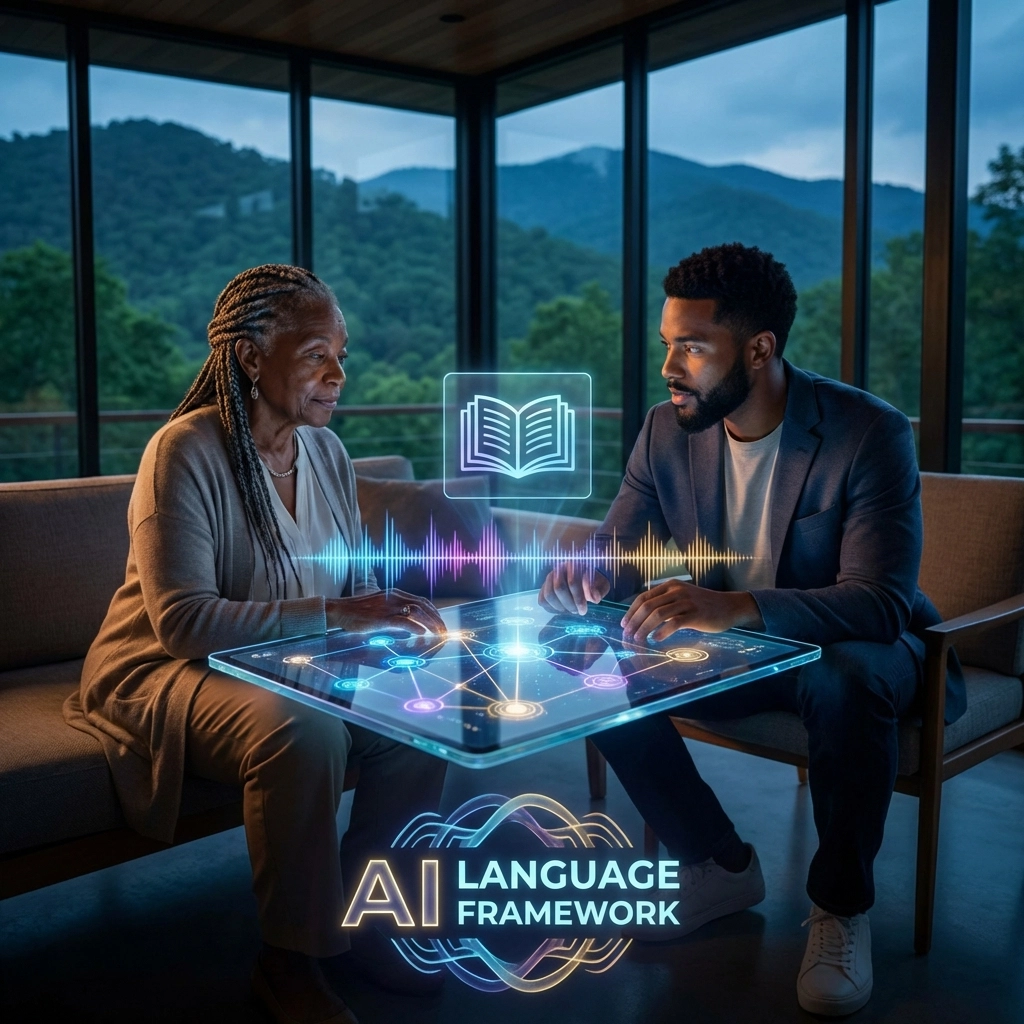
The preservation of indigenous languages stands at a critical crossroads where ancient wisdom meets modern technology. As communities worldwide face the urgent reality of language endangerment, artificial intelligence offers unprecedented opportunities: and equally significant responsibilities. Creating a practical framework for AI-driven language preservation requires careful balance between technological capability and cultural authenticity, ensuring that our digital tools serve rather than supplant the sacred relationship between people and their ancestral voices.
Foundation: Community-Led Governance
At the heart of any successful AI language preservation initiative lies community ownership and control. This means more than consultation: it requires establishing governance structures where indigenous communities retain full decision-making authority over their linguistic heritage.
Effective community governance begins with assembling a core team of native speakers, elders, linguists, and cultural knowledge keepers. These individuals form the foundation upon which all technological decisions rest. Their role extends beyond providing linguistic content; they serve as guardians of cultural context, ensuring that AI systems honor the deeper meanings embedded within language.

Communities must establish clear protocols for data ownership, particularly when working with recordings of speakers who may have passed away. This deeply culturally identifying information requires special protection and governance structures that respect both the living community and ancestral voices.
The governance framework should include:
- Elder councils with veto power over technological implementations
- Cultural review boards to assess AI outputs for cultural accuracy
- Community consent protocols for all data collection and usage
- Succession planning to ensure continuity across generations
Building Robust Digital Infrastructure
Creating comprehensive digital repositories forms the technological backbone of AI language preservation. These systems must accommodate audio recordings, textual materials, visual documentation, and contextual metadata while maintaining the highest security standards.
Modern preservation platforms, such as those developed through initiatives like Ejiogbe Voices, demonstrate how interactive environments can enable community members to engage with their cultural data in secure, managed spaces. Rather than accessing static archives, these platforms create living repositories where language continues to evolve and grow.
Essential infrastructure components include:
- Multi-format storage supporting various media types and quality levels
- Secure access controls protecting sensitive cultural information
- Backup and redundancy ensuring long-term preservation
- Scalable architecture accommodating growth over time
- Community-friendly interfaces enabling non-technical users to contribute
The infrastructure must also support both preservation and active use. This dual purpose ensures that archived materials remain vibrant and accessible to learners, educators, and community members while maintaining appropriate cultural boundaries.
Strategic AI Technology Integration
Implementing AI for indigenous language preservation requires specialized approaches designed specifically for low-resource languages. Mainstream language technologies, optimized for dominant languages with abundant training data, often fail when applied to endangered indigenous languages.
Effective AI strategies focus on:
Multilingual Transfer Learning: Leveraging models trained on widely spoken languages and adapting them to indigenous languages. This approach maximizes limited training data while maintaining linguistic accuracy.
Community-Validated Outputs: Every AI-generated translation, transcription, or linguistic analysis requires validation by community experts. This human-in-the-loop approach ensures cultural and linguistic fidelity.
Minimal Data Requirements: Developing AI systems that function effectively with limited training data, recognizing that many indigenous languages have small speaker populations and limited written materials.

Recent implementations have demonstrated remarkable efficiency gains: achieving 90% reduction in manual transcription work while maintaining 96% accuracy rates. This automation frees human experts to focus on culturally nuanced work, creative expression, and community education rather than repetitive data processing tasks.
Fostering Human-AI Collaboration
The most successful AI language preservation projects position technology as a collaborative partner rather than a replacement for human expertise. This partnership model recognizes that while AI excels at pattern recognition and data processing, human knowledge keepers provide irreplaceable cultural context and creative insight.
Optimal collaboration involves:
- AI handling routine tasks like initial transcription, data organization, and pattern identification
- Humans providing cultural interpretation, contextual meaning, and creative guidance
- Iterative refinement where AI outputs are continuously improved through human feedback
- Knowledge transfer where elders teach AI systems through guided interaction
This collaborative approach respects the wisdom of traditional knowledge keepers while leveraging technology to amplify their impact. Elders can work with AI tools to create more extensive educational materials, reach broader audiences, and ensure their knowledge transfers effectively to younger generations.
Ethical Safeguards and Cultural Protection
Every AI language preservation initiative must incorporate robust ethical safeguards from the outset. These protections address both immediate concerns about data misuse and longer-term implications of AI-generated content.
Critical safeguards include:
Elder Approval Protocols: All voice recordings and cultural content require explicit elder approval before inclusion in AI training datasets. This process respects traditional authority structures and ensures appropriate cultural representation.
Bias Detection and Mitigation: AI models can inadvertently introduce cultural biases from dominant languages. Regular assessment and correction processes help maintain linguistic and cultural authenticity.
Sacred Content Protection: Certain linguistic elements may be considered sacred or restricted. Clear protocols must distinguish between publicly shareable content and materials requiring special protection.

Usage Restrictions: Establishing clear boundaries around how AI-generated content can be used, ensuring that synthetic voices or translations never misrepresent community values or sacred knowledge.
These safeguards require ongoing vigilance and regular review as AI technologies evolve. Communities must maintain the authority to modify or strengthen protections as needed.
Implementation Partnerships and Collaboration
Successful AI language preservation typically involves collaboration between multiple stakeholders, each contributing unique expertise and resources. These partnerships must be structured to maintain community control while accessing necessary technical and academic support.
Effective partnership models include:
- Technology providers offering AI development expertise and infrastructure
- Academic institutions contributing linguistic research and validation methodologies
- Indigenous communities providing cultural knowledge and governance oversight
- Government agencies supporting funding and policy frameworks
International examples like the FLAIR initiative in Quebec and Te Hiku Media's "Kōrero Māori" project in New Zealand demonstrate how diverse stakeholders can collaborate effectively while respecting community values and regulatory requirements.
Partnership agreements should clearly define roles, responsibilities, and benefit-sharing arrangements. Communities must retain ownership of their linguistic data and maintain veto power over how that data is used by external partners.
Measuring Success and Impact
Establishing clear metrics helps communities track progress and make informed decisions about their AI language preservation initiatives. These measurements should reflect both technical achievements and cultural objectives.
Key performance indicators include:
Linguistic Accuracy: AI output accuracy as validated by community language experts, typically measured through systematic review processes.
Community Engagement: Active participation rates among different age groups, indicating successful knowledge transfer between generations.
Educational Impact: Measurable improvements in language learning outcomes and cultural knowledge retention.
Efficiency Gains: Reduction in manual labor required for language documentation and preservation tasks.
Cultural Preservation: Qualitative assessments of how well AI tools maintain cultural context and meaning.
Regular assessment ensures that technology serves community goals rather than driving them. Communities should feel empowered to modify or discontinue AI initiatives that don't meet their cultural or practical needs.
Moving Forward: Building Your Framework
Creating an effective AI language preservation framework requires careful planning, community consensus, and iterative development. Begin with small pilot projects that demonstrate value while building trust and technical capacity.
Start by identifying your community's specific needs and priorities. Some communities may prioritize educational applications, while others focus on archival preservation or revitalization efforts. Your framework should reflect these unique objectives while maintaining flexibility for future adaptation.
Consider exploring platforms like Ejiogbe Voices that offer community-focused tools and support structures specifically designed for indigenous language preservation. These resources can provide valuable starting points while maintaining community control over implementation decisions.
The preservation of indigenous languages through AI technology represents both an unprecedented opportunity and a sacred responsibility. By centering community governance, maintaining ethical safeguards, and fostering meaningful human-AI collaboration, we can create frameworks that honor ancestral wisdom while ensuring its transmission to future generations.
Our voices carry the weight of countless generations. With thoughtful application of AI technology, guided by community wisdom and cultural respect, we can ensure these voices continue to speak across time, preserving not just words but the living essence of cultural identity itself.