
In the sacred work of cultural preservation, we stand at a crossroads where ancient wisdom meets modern technology. As artificial intelligence becomes increasingly sophisticated, there's a tempting narrative that positions these systems as all-knowing oracles: capable of interpreting, analyzing, and even generating cultural content. But for indigenous communities and cultural preservation efforts, this approach represents a fundamental misunderstanding of AI's proper role.
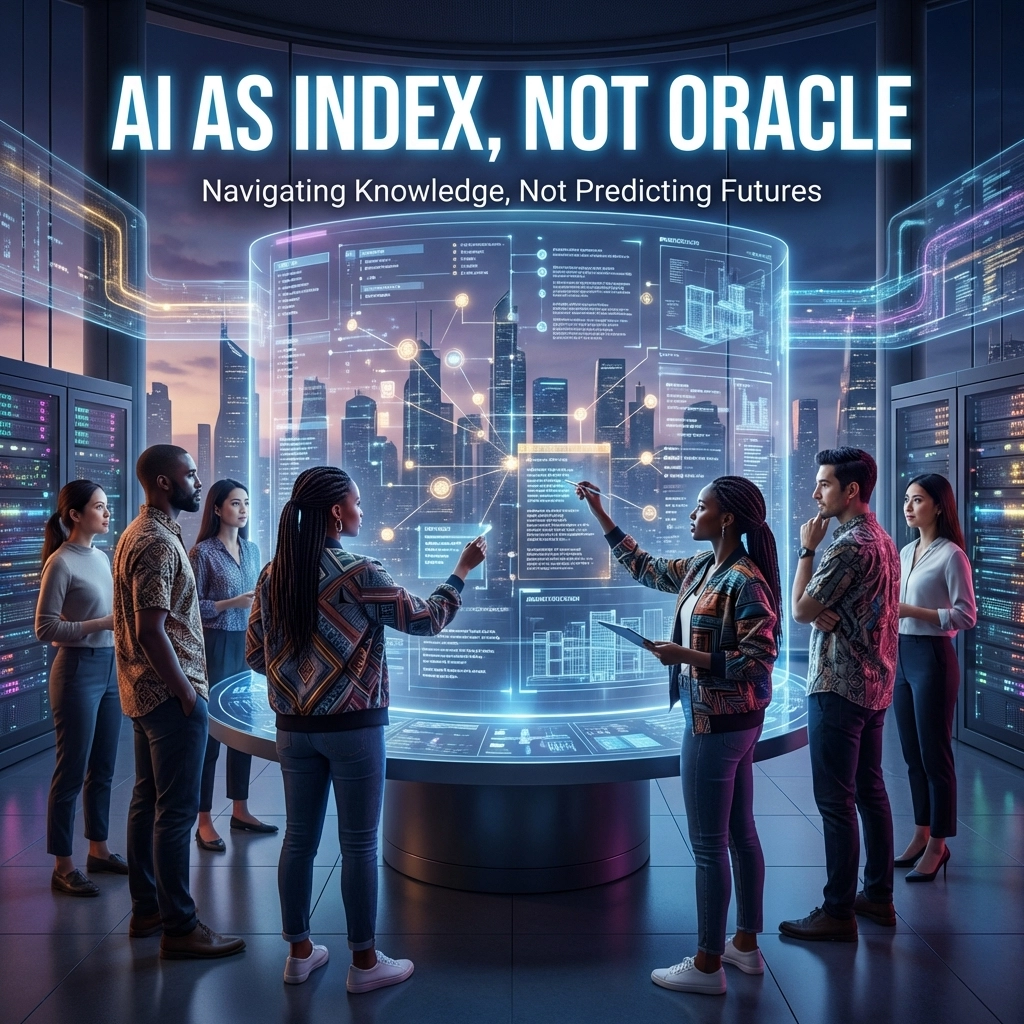
At Ejiogbe Voices, we champion a different vision: AI as index, not oracle. This distinction isn't merely technical: it's a matter of cultural sovereignty, respect for ancestral knowledge, and the preservation of authentic voices in our digital age.
The Oracle Trap: When AI Overreaches
The allure of treating AI as an oracle is understandable. Modern language models can process vast amounts of text, identify patterns, and generate seemingly intelligent responses. In the commercial world, this has led to AI systems being positioned as authorities: chatbots that answer customer questions with confidence, writing assistants that claim to "understand" context, and translation tools that promise perfect cross-cultural communication.

But when we apply this oracle mentality to cultural preservation, we encounter serious problems. Indigenous languages carry layers of meaning that extend far beyond literal translation. A single word might reference specific seasonal ceremonies, ancestral territories, or spiritual concepts that require years of cultural immersion to truly understand. When AI systems attempt to interpret or generate this content, they risk:
- Misrepresenting sacred knowledge through algorithmic assumptions
- Flattening complex cultural concepts into simplified digital formats
- Creating artificial "traditions" that never existed in the original culture
- Undermining elder authority by positioning machines as cultural experts
The oracle approach fundamentally conflicts with the principle that cultural knowledge belongs to the communities that created it, not to the systems that process it.
The Index Approach: AI as Cultural Librarian
Instead of treating AI as an interpretive authority, we can harness its genuine strengths as an organizational tool. Think of AI as the world's most capable librarian: someone who knows exactly where to find what you're looking for, but who would never presume to explain the deeper meaning of the texts they retrieve.
An AI index system excels at:
Pattern Recognition and Organization
AI can identify linguistic patterns, catalog speaker variations, and organize content by themes, regions, or time periods. When an elder shares a traditional story, AI can help categorize it alongside similar narratives, making it easier for community members to explore related content.
Search and Retrieval
Natural language processing allows community members to search archives using conversational queries. Instead of navigating complex folder structures, users can ask "find recordings about harvest ceremonies" and receive relevant results instantly.
Content Connections
AI can identify relationships between different pieces of cultural content: connecting a lullaby recorded by one elder to similar songs shared by relatives, or linking contemporary language use to historical examples in the archive.

Multilingual Navigation
For communities working to revitalize dormant languages, AI can help bridge gaps by identifying cognates, similar grammatical structures, and related vocabulary across linguistic families.
Preserving Authority: Elders as Final Arbiters
The index approach maintains clear boundaries around cultural authority. While AI organizes and retrieves content, human wisdom guides interpretation and meaning-making. This creates a powerful partnership where:
Elders maintain interpretive authority over all cultural content, with AI serving as their digital assistant rather than their replacement.
Community members can explore heritage through intuitive search interfaces while always being directed back to authentic sources: the elders, cultural practitioners, and community members who carry living knowledge.
Cultural context remains intact because AI systems never attempt to explain or interpret content independently, instead connecting users with the appropriate human authorities.
Sacred boundaries are respected through permissioned access systems that honor community protocols around sensitive knowledge.
Technical Implementation: Building Respectful Systems
Creating AI systems that serve as indexes rather than oracles requires intentional technical design. At Ejiogbe Voices, our approach focuses on several key principles:
Metadata-Rich Organization
Every piece of cultural content includes extensive metadata: speaker information, cultural context, appropriate audience, and usage permissions. AI uses this metadata to organize and retrieve content without making assumptions about meaning.
Community-Controlled Taxonomies
Rather than imposing external classification systems, our AI learns from community-defined categories and organizational structures. If a particular language group organizes stories by seasonal cycles, the AI adopts that framework.

Attribution and Sourcing
Every AI-mediated interaction includes clear attribution to human sources. When users search for content, results always identify the original speakers, cultural context, and any relevant permissions or restrictions.
Fallback to Human Expertise
When AI systems encounter ambiguity or complex queries, they direct users to human experts rather than attempting interpretation. This preserves the role of elders and cultural practitioners as primary authorities.
Beyond Search: AI as Cultural Infrastructure
The index approach extends beyond simple search functionality. AI can serve as cultural infrastructure in several ways:
Archive Management
AI helps maintain the technical aspects of digital archives: ensuring file integrity, managing backups, organizing storage systems, and facilitating migration to new formats as technology evolves.
Access Control
Sophisticated AI systems can help implement community-defined access protocols, ensuring that sensitive content reaches appropriate audiences while making public materials widely available.
Quality Assurance
AI can identify technical issues with recordings: poor audio quality, incomplete metadata, or formatting problems: without making judgments about cultural content.
Usage Analytics
Communities can use AI-powered analytics to understand how their cultural materials are being accessed and used, helping inform preservation priorities and outreach efforts.
The Wisdom of Restraint
Perhaps the most important aspect of treating AI as index rather than oracle is what we choose not to build. We resist the temptation to create:
- AI chatbots that roleplay as ancestral figures
- Automatic translation systems that claim cultural equivalence
- Content generation tools that produce "traditional" stories
- Interpretation engines that explain cultural meanings
This restraint isn't a limitation: it's a form of respect. By acknowledging what AI cannot and should not do, we create space for authentic cultural transmission to occur between generations of community members.

Building Trust Through Transparency
The index approach builds trust with indigenous communities because it maintains transparency about AI capabilities and limitations. Community members understand exactly what the technology does (organize, search, retrieve) and what it doesn't do (interpret, analyze, generate). This clarity helps communities make informed decisions about their participation in digital preservation efforts.
When elders contribute their knowledge to digital archives, they can trust that their words won't be manipulated, reinterpreted, or used to train systems that might misrepresent their culture. The AI serves their community's needs without claiming authority over their heritage.
Moving Forward: Technology in Service of Community
As AI technology continues advancing, the temptation to position these systems as oracles will only grow stronger. For those of us working in cultural preservation, maintaining the index approach becomes both a technical challenge and a moral imperative.
The communities we serve deserve technology that amplifies their voices rather than replacing them. They deserve systems that connect them with their heritage while respecting the wisdom of their elders. They deserve AI that serves as a bridge between generations, not a barrier to authentic cultural transmission.
At Ejiogbe Voices, we're committed to building technology that honors these principles. Our platform treats every cultural contribution as sacred knowledge deserving of the highest respect: organizing it, preserving it, and making it accessible to community members while never presuming to interpret its meaning.
The future of cultural preservation lies not in creating artificial oracles, but in building intelligent indexes that serve human wisdom. In this approach, technology becomes what it should always be: a tool in service of community, heritage, and the irreplaceable knowledge that flows from elder to child across generations.
By choosing AI as index over oracle, we choose respect over replacement, organization over interpretation, and service over authority. This isn't just a technical decision: it's a commitment to ensuring that ancestral voices remain exactly that: ancestral, authentic, and forever belonging to the communities that created them.