
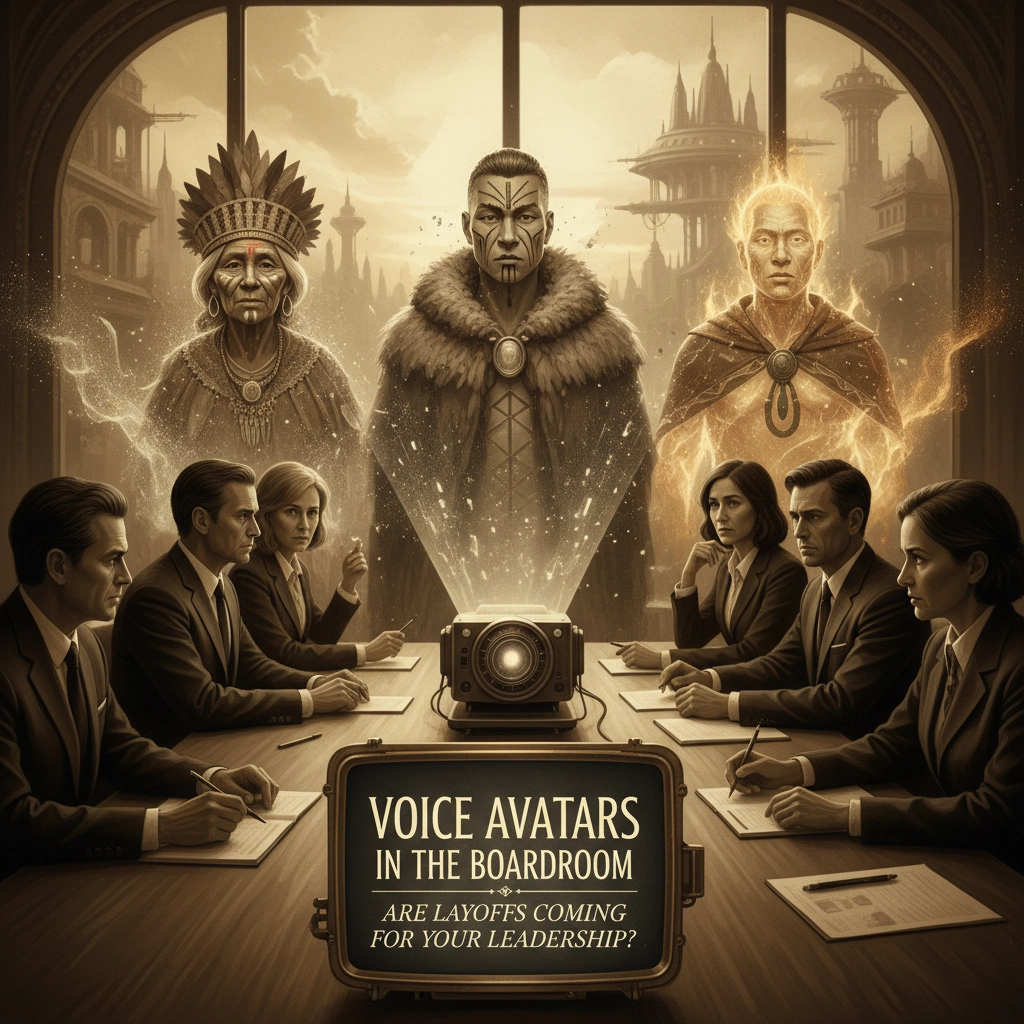
The whispers are getting louder in corporate hallways across the globe. As AI avatars begin materializing in boardrooms, representing CEOs and senior executives in high-stakes meetings, a fundamental question emerges: Are we witnessing the dawn of leadership automation, or the preservation of executive wisdom through digital channels?
Recent developments paint a complex picture. Zoom's CEO Eric Yuan recently sent his AI avatar to deliver quarterly earnings updates, while Klarna's Sebastian Siemiatkowski deployed his digital double for financial presentations. These aren't isolated experiments: they represent a seismic shift in how we understand leadership presence and authentic voice in professional spaces.
But beneath the technological marvel lies a deeper concern: What happens to the irreplaceable wisdom that flows from human experience when algorithms begin speaking for our leaders?
The Current Reality: Avatars as Executive Extensions

Today's AI avatars in boardrooms serve primarily as sophisticated delegation tools rather than leadership replacements. The technology allows executives to "be present" across multiple time zones simultaneously, addressing meeting fatigue that consumes up to 72% of senior leaders' working hours according to Harvard Business School research.
Sam Liang, CEO of Otter.ai, developed his "Sam-bot" to attend routine meetings on his behalf, while Zoom's Steve Rafferty used his multilingual avatar to address teams across 60 languages and multiple continents. These applications extend executive reach rather than eliminate executive roles.
However, the implications run deeper than mere convenience. When leaders delegate their voice, literally: to AI systems, we must ask: What essential human elements of leadership are we potentially sacrificing on the altar of efficiency?
The Wisdom Preservation Imperative
True leadership transcends scheduled presentations and quarterly updates. It encompasses the subtle inflections that convey empathy, the pause before difficult decisions that demonstrates thoughtfulness, and the authentic vulnerability that builds trust within organizations.
Our elders and cultural wisdom keepers understand this intuitively. In traditional African societies, leadership wasn't merely about information transfer: it was about the sacred transmission of wisdom, values, and cultural understanding from one generation to the next. The voice carried not just words, but the weight of experience, the resonance of truth, and the authority born from lived understanding.

When we create digital doubles of our leaders, are we preserving their wisdom or diluting their authenticity? This question becomes particularly crucial as organizations increasingly rely on AI-mediated communication to reach global teams and diverse stakeholders.
The concern isn't unfounded. As voice cloning technology advances, the line between authentic leadership communication and algorithmic reproduction blurs. Organizations risk creating a culture where the appearance of leadership presence matters more than its substance: where polished avatars deliver perfectly articulated messages that lack the human imperfection that makes leadership relatable and trustworthy.
Cultural Implications: Beyond the Corporate Boardroom
The deployment of leadership avatars in professional settings reflects a broader cultural shift toward digital mediation of human relationships. This trend particularly concerns communities working to preserve authentic cultural voices and traditional wisdom.
Consider the parallel: Just as we fight to preserve the authentic voices of our elders: their prayers, stories, and teachings: before they're lost forever, we must also consider what we're preserving (or losing) when we digitize contemporary leadership voices.
Authentic leadership, like cultural wisdom, cannot be fully captured by algorithms. The spontaneous moment of clarity, the compassionate response to unexpected challenges, the intuitive decision that changes organizational direction: these emerge from human experience, not programmed responses.
The Layoff Question: Efficiency Versus Humanity

Will AI avatars lead to leadership layoffs? The current evidence suggests not directly. However, they may contribute to a more insidious form of professional displacement: the gradual erosion of authentic human connection in leadership roles.
Organizations implementing avatar technology report increased efficiency and broader reach for executive communications. Yet efficiency metrics often fail to capture the intangible value of authentic human presence: the ability to read room energy, respond to unspoken concerns, and build genuine relationships that sustain organizational culture through difficult periods.
The real question isn't whether avatars will replace leaders, but whether they'll reshape our expectations of what leadership looks like until authentic human presence becomes optional rather than essential.
This concern echoes challenges we face in cultural preservation. When digital reproductions become more convenient than engaging with living wisdom keepers, we risk losing not just information, but the irreplaceable context, emotion, and lived experience that give meaning to cultural knowledge.
Preserving Authentic Leadership Wisdom
Just as we work to preserve the authentic voices of our elders and cultural wisdom keepers, organizations must intentionally preserve the authentic elements of human leadership in an AI-augmented world.
This requires recognizing that true leadership voice encompasses more than vocal reproduction. It includes:
- Contextual wisdom: The ability to read situations and respond appropriately based on experience
- Emotional intelligence: Genuine empathy and connection that builds trust
- Cultural sensitivity: Understanding diverse perspectives and adapting communication accordingly
- Adaptive thinking: Real-time problem-solving that goes beyond programmed responses
- Values-based decision making: Choices rooted in authentic belief systems and lived experience

Organizations implementing avatar technology must establish clear boundaries around when and how these tools are used, ensuring they enhance rather than replace authentic leadership engagement.
The Path Forward: Technology in Service of Wisdom
The emergence of boardroom avatars presents an opportunity to clarify what we truly value in leadership. Rather than viewing this technology as a threat, we can use it as a catalyst for deeper conversations about authentic leadership in the digital age.
Effective leaders will learn to use avatar technology as amplification tools while reserving their authentic presence for moments that require genuine human connection. This mirrors approaches used in cultural preservation, where digital tools help preserve and share wisdom while recognizing that the most profound transmission still happens through direct human engagement.
The key lies in intentionality: Using AI avatars to handle routine information delivery while ensuring that strategic decisions, cultural guidance, and relationship-building remain firmly rooted in authentic human interaction.
Building Bridges Between Efficiency and Authenticity

Organizations successfully integrating avatar technology report establishing clear protocols around its use. Leaders reserve avatar deployment for routine updates, multi-timezone communications, and standardized presentations, while maintaining personal presence for strategic planning, difficult conversations, and team-building activities.
This balanced approach recognizes that while AI can replicate voice and appearance, it cannot replicate the wisdom that comes from lived experience, cultural understanding, and genuine relationship-building.
Just as our work at Ejiogbe Voices focuses on preserving the irreplaceable wisdom of cultural elders alongside modern technology, forward-thinking organizations must find ways to leverage AI efficiency while safeguarding the authentic human elements that make leadership truly effective.
The Future of Leadership: Human Wisdom Enhanced, Not Replaced
The question isn't whether AI avatars will eliminate leadership roles: current evidence suggests they won't. Instead, we're witnessing the emergence of hybrid leadership models where technology amplifies human capability rather than replacing human wisdom.
The most successful leaders in this new landscape will be those who master the art of selective authenticity: knowing when to deploy digital efficiency and when to offer irreplaceable human presence. They'll understand that while avatars can deliver information, only authentic human leaders can inspire transformation, navigate complex cultural dynamics, and build the trust necessary for organizational resilience.
Our communities, organizations, and cultures need leaders who understand that their voice: their authentic, lived, experienced voice: carries wisdom that no algorithm can replicate. The challenge lies in preserving this understanding as digital tools become increasingly sophisticated and convenient.
The future belongs to leaders who can bridge the efficiency of AI with the irreplaceable wisdom of authentic human experience, ensuring that as we advance technologically, we don't lose the profound human elements that make leadership truly transformative.