
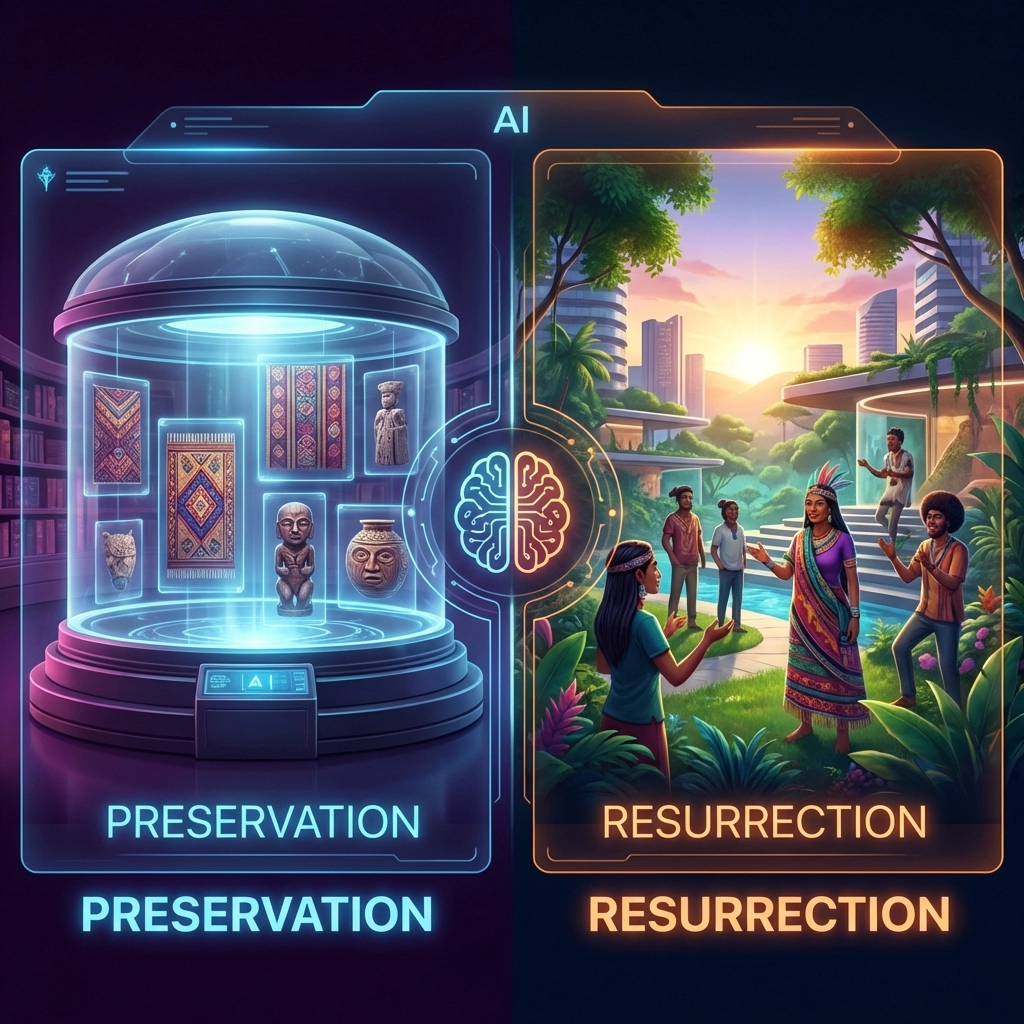
When we speak about indigenous languages and AI, we often use terms like "revival," "restoration," and "preservation" interchangeably. But these words carry profound differences that can determine whether our technological efforts honor ancestral wisdom or overstep sacred boundaries. Understanding the distinction between preservation and resurrection isn't just academic: it's essential for anyone working with indigenous language technologies.
Preservation: Maintaining What Lives
Preservation, at its core, means maintaining and securing something in its existing state. In indigenous language work, preservation acknowledges that these languages are living entities with their own spirits, protocols, and proper contexts. When we preserve, we act as careful stewards, creating stable environments where languages can continue to exist as they are.
True preservation recognizes that many indigenous languages are not "dead" or "dormant": they exist in the memories of elders, in ceremonial contexts, in family conversations, and in the hearts of communities. Our role becomes one of documentation, protection, and creating pathways for natural transmission between generations.

Think of preservation like maintaining a sacred fire. The fire already exists; our job is to provide the right conditions: proper fuel, protection from wind, careful tending: so it can continue burning. We don't create the fire; we honor its presence and ensure its continuity.
In practical terms, preservation means:
- Recording elders speaking in natural contexts
- Documenting traditional protocols and proper usage
- Creating archives that communities control
- Supporting existing speakers and learners
- Facilitating intergenerational transmission
Resurrection: The Dangerous Transformation
Resurrection, by contrast, represents a fundamental transformation that creates something entirely new. While this concept holds sacred meaning in spiritual contexts, applying resurrection logic to indigenous languages crosses ethical boundaries that technology should never approach.
When we speak of "resurrecting" a language, we imply death followed by artificial reanimation. This framing is not only culturally insensitive but fundamentally misunderstands the nature of indigenous languages. Languages don't simply "die" and return: they exist in complex relationships with communities, ceremonies, and ancestral protocols.
AI resurrection attempts often involve:
- Generating "new" content in indigenous languages
- Creating synthetic voices of ancestors or elders
- Producing conversations or teachings that never existed
- Filling gaps in knowledge with algorithmic guesses
- Presenting AI output as authentic cultural content

The danger lies not just in inaccuracy, but in the spiritual and cultural violations these approaches represent. Many indigenous communities understand languages as having spirits, as being connected to specific ancestors, and as carrying protocols that govern their proper use. Resurrection attempts can violate these sacred relationships.
Why "Revival" Claims Often Miss the Mark
The term "language revival" has become popular in academic and tech circles, but it often carries resurrection assumptions that indigenous communities find problematic. Revival suggests bringing something back from death, implying that communities have lost their connection to their languages entirely.
This framing overlooks the complex ways languages persist even when they're not spoken daily. Languages live in:
- Ceremonial contexts and spiritual practices
- Place names and family names
- Traditional stories and songs
- Cultural concepts that don't translate
- The dreams and prayers of elders
When tech companies claim to "revive" languages, they often mean creating synthetic content or generating new usage patterns. But true language vitality comes from communities themselves: from children learning from elders, from families making conscious choices to speak their languages, from communities creating contexts where their languages thrive.

At Ejiogbe Voices, we focus on preservation technologies that support natural language transmission rather than artificial revival attempts. Our approach centers community agency and elder authority.
The Sacred Nature of Ancestral Voices
Perhaps nowhere is the preservation-resurrection distinction more critical than in how we handle the voices of ancestors and elders. Recording and preserving elder voices represents profound preservation work: maintaining these precious sounds so future generations can hear their ancestors speak.
But using AI to synthesize new content in an elder's voice, especially after they've passed on, crosses into resurrection territory. This practice:
- Violates many indigenous protocols around ancestor voices
- Creates artificial teachings that elders never gave
- Can cause spiritual distress in communities
- Misrepresents the limited, precious nature of recorded words
Indigenous communities often have specific protocols governing how ancestor voices should be shared, when they can be heard, and who has permission to access them. AI synthesis typically ignores these protocols entirely.
Practical Guidelines for Respectful Technology
Understanding preservation versus resurrection leads to clear practical guidelines for anyone developing language technologies:
Preservation Approaches:
- Archive exact recordings without modification
- Create searchable databases of existing content
- Support community-controlled access systems
- Facilitate connections between speakers and learners
- Document cultural protocols and contexts
Resurrection Red Flags:
- Generating new content in indigenous languages
- Creating synthetic elder or ancestor voices
- Filling knowledge gaps with AI assumptions
- Presenting algorithmic output as cultural truth
- Bypassing community authority and protocols

The Technology We Actually Need
Communities consistently express need for preservation technologies that respect boundaries while creating practical benefits. Effective language preservation technology:
- Respects community sovereignty over their linguistic heritage
- Maintains cultural protocols around access and sharing
- Supports natural learning rather than artificial generation
- Preserves context alongside linguistic content
- Centers elder authority in all decision-making
Our documentation system reflects these principles, providing tools that enhance preservation work while maintaining clear boundaries around what technology should and shouldn't attempt.
Moving Forward with Wisdom
The distinction between preservation and resurrection isn't just philosophical: it's practical guidance for creating technology that serves indigenous communities rather than exploiting them. When we preserve, we act as allies supporting community-led efforts. When we attempt resurrection, we risk becoming colonizers using technology to override indigenous authority.
As AI capabilities grow more sophisticated, these distinctions become more crucial. The technology that can synthesize voices and generate content will be tempting to use in indigenous language contexts. But having the technological capability doesn't grant us the cultural or spiritual authority to use it.

True progress in indigenous language technology comes from understanding these boundaries, respecting them, and building tools that enhance preservation while supporting community sovereignty. The future of indigenous languages depends not on what technology can do, but on what it should do: and what it should never attempt.
The line between preservation and resurrection isn't just a technical specification: it's a sacred boundary that determines whether our technology serves as bridge or barrier between generations. Choose preservation. Honor the difference. Respect the line.
Our communities deserve technology that recognizes the sacred nature of ancestral voices while supporting the living work of language transmission. That's the technology we build, and that's the boundary we maintain.
For communities interested in preservation approaches that respect these principles, explore our mission and guidelines for ethical language technology development.